
Greece may be famous for ancient ruins, beautiful islands, clear blue water and incredible food—but it’s the little practical details that can make your first trip so much easier. Here‘s my Greece Travel Guide with the tips and facts I wish I knew before we went.
Planning your first trip to Greece? You are going to love it! You’re probably already dreaming about temple ruins, Greek islands, turquoise water, whitewashed villages and plenty of gyros.
But once the trip is booked, then the practical questions start. Do I need cash? Can I drink the water? How does the Schengen Zone work? Will my phone work? And do I need to learn Greek? This Greece Travel Guide will answer all those questions and more.
Bill & I spent two weeks traveling through Greece, including a cruise to several Greek Islands with several days in Athens before and after our cruise. As an experienced world traveler, I’ve learned that knowing some little details ahead of time can save a surprising amount of confusion once you arrive.
This Greece Travel Guide pulls together the practical Greece travel tips I wanted to know before our Bucket List trip, and the things we learned once we got there. I’ve done the research—and made some mistakes—so you can skip the analysis paralysis and just enjoy your time in Greece.

Quick Greece Travel Guide for First-Time Visitors
Before we get into the details, here are a few Greece facts that will help you get your bearings quickly.
- Currency: Euro (€)
- Language: Greek, although we found English widely spoken
- Schengen Area: Yes
- Known for: Ancient ruins, Greek islands, Mediterranean food, beaches and incredibly clear blue water
- Time zone: Eastern European Time (EET)
- Tap water: Generally safe to drink in Athens and many larger destinations, but water quality and taste vary on the islands. When in doubt, ask your lodging.
Kari’s Travel Tip: We never had to figure out how to say anything in Greek. Everyone we encountered spoke English very well, which made Greece surprisingly easy for us to navigate.
Planning a Greece cruise? I also have guides to What to Pack for a Greece cruise and our firsthand Celebrity Infinity Review, including what we liked, what we didn’t and what I’d want to know before booking.


PLAN YOUR TRIP WITH OUR
FAVORITE TOOLS
– Best Lodging site: Booking.com
– Book Day Tours here: Viator.com
– Rent Cars here: DiscoverCars.com
Greece Entry Requirements, Schengen & EES
If you’re traveling to Greece from the United States, there are a few Europe entry rules you need to understand before you go.
Greece is part of the Schengen Area, a group of European countries that share common entry rules. For American tourists with a valid US passport, that generally means you can visit the Schengen Area for up to 90 days within any 180-day period without a visa.
And that is 90 days for the entire Schengen Area—not 90 days in each country.
Your passport should also be valid for at least three months beyond your planned departure from the European Union. Entry requirements can change, so I always check the current requirements on the US State Department website before any international trip. Check Current Greece Entry Requirements
What Is the EES?
The Entry/Exit System, or EES, is a new process for Americans traveling to Europe. The EU is using it to track our Schengen entries and exits electronically, rather than using passport stamps. This bummed me out because I have a brand new passport and I didn’t get a single stamp added to it! ☹
The EES system collects information including your passport details, facial image, fingerprints and entry and exit dates. Learn more about it here.
We experienced this firsthand on our way to Greece.
Our flight connected through Amsterdam, so the Netherlands—not Greece—was where we actually entered the Schengen Area. We registered for EES there, and the system had trouble reading my fingerprints. I’m not sure why.
When I tried to go through Immigration, the automated system rejected me due to my fingerprints not registering. That was not very reassuring. Thankfully, the border patrol agent just waved me through, and we continued on to Athens without any additional problems.
Kari’s Travel Tip: Your first Schengen country may not be your final destination. If you connect through Amsterdam, Paris, Frankfurt or another Schengen airport on your way to Greece, you may complete immigration and EES procedures there.
Read the State Department’s Information for US Travelers in Europe

Is Greece Safe for First-Time Visitors?
We felt very comfortable traveling around Greece, including walking around Athens and exploring several islands.
The biggest safety warning you need to know is about pickpockets.
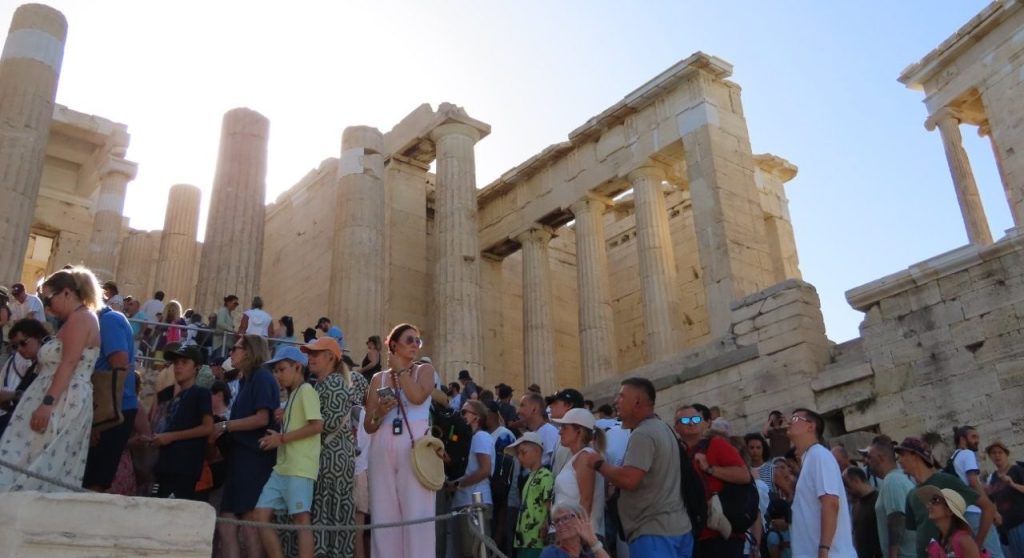
During our Acropolis tour, our guide specifically warned us to watch our belongings as we approached the more crowded areas near the Parthenon. We also encountered very crowded streets on Santorini where we were shoulder to shoulder with other tourists. That’s the kind of environment where I’m particularly careful with my purse, phone and camera.
The US State Department is the source I check before every international trip for current safety information, entry requirements and any travel advisories that could affect our plans. Check the Current Greece Travel Advisory
Register for the STEP Program
Bill & I also register all our international trips with the US State Department’s Smart Traveler Enrollment Program, or STEP.
It allows the State Department to send you information about safety conditions or emergencies that could affect your destination. In the past, we have received email notices of protests in Rome, Buenos Aires and Santiago Chile. I like knowing they have our travel information if something significant happens while we’re overseas.

US Embassy in Athens
I also like having the nearest US Embassy information available before I need it.
US Embassy Athens
91 Vasilisis Sophias Avenue
10160 Athens, Greece
Main telephone: +30-210-721-2951
Emergency after-hours: +30-210-721-2951
Email: AthensAmericanCitizenServices@state.gov
Website: US Embassy in Greece
Kari’s Travel Tip: Save important emergency numbers and embassy information in your phone before your trip. Hopefully you’ll never need any of it—but an emergency is not the time I want to start Googling.
Money in Greece: Euros, Cash & Credit Cards
Greece uses the Euro (€), which makes things easy if Greece is part of a longer European trip.
We found Greece very easy when it came to paying for things. Credit cards are widely accepted, although it’s still smart to carry some Euros for smaller purchases and places that prefer cash. The State Department also notes that some vendors, including taxis, may request cash.
One of my favorite Greece bargains was the gyros for €4 or €5 each. This was our go-to meal several times. Not everything in Greece is that cheap, but I certainly wasn’t complaining about an €8 dinner for two!

Currency Conversion
I use the Xe app when I need to check the current exchange rate.

Kari’s Travel Tips:
- Use a bank ATM if you need Euros rather than an ATM in a tourist area.
- Always choose Euros—the local currency—if a credit card terminal asks whether you want to pay in Euros or US dollars.
- Carry a little cash, even if you plan to use your credit card most of the time. Bathrooms sometimes require a 1€ coin to access.
- Try to spend your leftover coins and small bills before leaving Europe. Snacks and beverages on the final travel day are a good way to use them up.

Tipping in Greece
Tipping in Greece is much less aggressive than what we’re used to in the United States.
You do not need to automatically add a 20% tip every time someone serves you food. Restaurant bills may already include a service charge, so look at the bill before adding more. If service isn’t included, rounding up or leaving a modest tip for good service is common. Taxi fares are also commonly rounded up.
We tipped our tour guides, particularly when we had a good experience. We also tipped drivers and other people who provided us with personal service.
Kari’s Travel Tip: Don’t automatically apply US tipping habits in another country. Check the bill first, then decide what makes sense based on the service you received.
Getting Around Greece
One thing that surprised me was how many different forms of transportation we used in Greece without ever renting a car.
Between Athens, Piraeus and our cruise, we used the Metro, Uber taxis, buses, cruise shuttles, tenders and cable cars.
Athens Metro
We took the Metro directly from the Athens airport to the port area of Piraeus when we first arrived in Greece.
It was crowded, especially with all our luggage, but it got us where we needed to go. And it was way cheaper than taking a taxi.
Kari’s Travel Tip: Save your lodging address in Google Maps before you leave home. Better yet, download an offline map of the area. You do not want your entire navigation plan dependent on having data the minute you land.
Taxis and Uber
We used Uber frequently in Athens and Piraeus. Taxi drivers are the only ones authorized to use the Uber app so you won’t see any private cars coming to pick you up.
We scheduled one to take us from our Piraeus Airbnb to the cruise terminal and used it several times in Athens when we didn’t want to walk or deal with public transportation.
I liked using Uber because then 1) I knew what the price was going to be without having to negotiate with the driver, 2) the prices were shown in USD rather than Euros, 3) I can watch the driver as he approached our waiting spot, 4) I could use my credit card via the app instead of needing cash and 5) all the safety precautions that are built into the Uber app.
Kari’s Travel Tip: At airports, cruise terminals and busy tourist attractions, pay close attention to the pickup location shown in the Uber app. Your driver may not be able to pull up exactly where you are standing.
Leaving the cruise terminal after we disembarked, we had a little trouble figuring out exactly where Uber wanted to pick us up. We finally made our way outside Terminal Gate 12, where our driver could reach us.
Buses
In Athens, we bought 48-hour Hop-On/Hop-Off Bus tickets with the Big Bus company and used them for both transportation and sightseeing.
We rode the routes around Athens and along the coast, getting off when something interested us. It was an easy way to cover more ground without having to figure out the local bus system.
We bought our 48-hour ticket mid-day on Monday. Used it Monday afternoon, all day Tuesday and also on Wednesday morning. So portions of 3 days for the price of 2!

If Athens is part of your trip, I put together our Athens Itinerary for 2 Days Before or After a Cruise, including how we combined the Acropolis, the Hop-On/Hop-Off bus, an evening walking tour and the Athens Riviera.
Ferries and Island Transportation
Ferries are an important part of transportation in Greece, especially if you’re traveling between Athens and the islands.
Even though we visited the Greek islands by cruise ship rather than independently by ferry, we stayed near the Piraeus harbor long enough before our cruise to watch the ferries constantly coming and going.
If you’re building an island-hopping trip, ferry schedules and port locations will be a much bigger part of your planning than they were for us.

Driving in Greece
We didn’t rent a car in Greece and frankly never felt like we needed one. Public transportation, Uber taxis, tours and private drivers took us everywhere we wanted to go, so I can’t give you firsthand advice about driving here.
Staying Connected in Greece
I rely heavily on my phone when we travel internationally. Maps, Uber, WhatsApp, email, restaurant searches, tour confirmations—I want data.
Airalo eSIM
I set up my account on the Airalo website, then used the Airalo App to buy an Airalo Europe eSIM for $19 USD that covered 15 days. That was the price for our 2026 trip, so check current pricing.
BUT, be careful in the App to determine whether the pricing is for an Unlimited plan or a Fixed number of GB plan. At first, I thought the prices seemed way more expensive than I remembered them being for previous eSIM purchases. Then I realized I was in the Unlimited tab. I switched to the Fixed Data plan and bought a 5 GB for 15 days eSIM. Later, I topped it off with another 2 GB when I got low towards the end of our trip.
This data only eSIM doesn’t allow you to make calls on your home-based phone number. But WhatsApp does (see below).

My Airalo experience in Greece also came with a good reminder: technology doesn’t always cooperate exactly when you need it.
For some reason, when we first landed in Athens, my eSIM wasn’t working. That made our Metro-to-Airbnb arrival a lot more challenging than I wanted it to be. When we got to our Airbnb, I got on Wi-Fi and then I contacted Airalo. They helped me troubleshoot a few settings on my phone to fix it.
Once it was working, I used Airalo throughout our Greece trip. It even gave me Internet access on our cruise whenever we were in port or close enough to land to pick up cellular service.
Kari’s Travel Tip: Make sure your phone is unlocked before buying an eSIM – call your cellular provider to make sure. Install your eSIM before leaving home so you’re not trying to figure it out after a long international flight. But also download your maps and save important addresses as a backup.
We also skipped the ship’s WiFi package completely on our Greece cruise. If you’re trying to decide which cruise extras are actually worth paying for, my Cruise Drink Package Guide compares what happened when we bought the full package on one cruise and skipped the packages entirely on another.
I use WhatsApp with my US number on my phone whenever we travel internationally because almost everywhere in the rest of the world (South America, Europe, Africa, Australia/New Zealand and SE Asia for sure based on us traveling there) uses it for calls, texts and sharing information. This means your tour guides, drivers, lodging hosts and other businesses will be using WhatsApp to communicate with you.
It works over Wi-Fi or cellular data, using your US Based number, so I can use WhatsApp with my eSIM without relying on my normal US cellular plan.

It’s also how our kids and family members communicate with us when we are out of the country. And I text them photos of our trip in real time.
Kari’s Travel Tip: Download WhatsApp before leaving home and make sure you know how to use it. That’s much easier than figuring it out when a driver is trying to contact you. And get your family to download it too so you can stay in touch.

Electrical Outlets in Greece
Greece uses Type C and Type F electrical outlets—the European-style outlets with two round pins. The electrical system operates at 230 volts and 50 Hz.

If you’re traveling from the United States, you’ll need a plug adapter for standard US plugs. I love my Ceptics Travel Adapter – it gives me all the outlets I need and have used it all over the world.

An adapter only changes the shape of the plug. It does not change the voltage.
Many phones, laptops, cameras and other electronics are designed for both US and European voltage, but check the tiny print on the charger before plugging it in. Appliances such as hair dryers and curling irons can be a different story.
Kari’s Travel Tip: I always travel with multiple plug adapters because Bill & I have phones, watches, cameras, laptops and other electronics that seem to multiply the minute we arrive somewhere.
Can You Drink the Tap Water in Greece?
This is one of those questions where a blanket yes or no isn’t particularly helpful.
According to the US State Department, tap water is generally safe for drinking and cooking in major cities and on larger islands. On some of the more arid islands, however, water may be imported or desalinated, and travelers may prefer bottled water.
So my rule would be simple: ask.
If you’re in Athens or another major city, tap water is generally considered safe. On an island, ask your hotel or Airbnb host what they recommend locally.
Kari’s Travel Tip: I’d rather ask one simple question at check-in than spend the entire trip wondering whether I should drink the water.
Public Toilets and Bathrooms in Greece
We didn’t encounter any major bathroom surprises in Greece that made me think, “Travelers need to be warned about this.”
And sometimes that is useful information too.
As with the rest of Europe, I still keep a few Euro coins with me when we’re out exploring because you never know when you’ll encounter a public restroom that charges a small fee to use.
Kari’s Travel Tip: Never pass up a clean bathroom when you have one available. That may be one of my most universal travel rules!
Time Zone in Greece
Greece uses Eastern European Time (EET) and switches to Eastern European Summer Time (EEST) during daylight saving time.
During our August trip, Greece was eight hours ahead of Minnesota.
I add our destination to the World Clock on my iPhone before leaving home. That makes it easy to check both time zones without doing math in my head.
Kari’s Travel Tip: Don’t memorize “Greece is X hours ahead of me” because daylight saving changes can temporarily alter the difference. Add Athens to your phone’s World Clock and let your phone do the work.

Date Format in Greece
Greece generally writes numeric dates day/month/year rather than the month/day/year format most Americans use.
So 08/12/2026 means December 8—not August 12.
This is especially important when you’re looking at tickets, reservations or filling out forms. Pay especially close attention when putting in the Issue or Expiration date of passports.
Kari’s Travel Tip: Any time I see an all-numeric date overseas, I stop for a second to check the format.
Greece International Phone Code
Greece’s international country code is +30.
If you need to call a Greek number from your US phone while traveling, you’ll typically see the number written with +30 in front of it.
This is also why the US Embassy phone number begins with +30.
Little Things That Surprised Me About Greece
Sometimes the things I remember most aren’t the facts I researched before the trip. They’re the little everyday differences I noticed once we arrived.
Everyone We Encountered Spoke English
This was one of the biggest pleasant surprises.
Greek is the official language, but we literally never had to figure out how to say anything in Greek. Everyone we encountered in hotels, restaurants, shops, tours and transportation spoke English very well.
I’m sure that won’t be true in every corner of the country, but in the places we visited, language was never a barrier.

Smoking Was Much More Noticeable
Walking through the towns we visited, I suddenly remembered how much more visible smoking can be in Europe than what we’re used to at home.
More than half of the employees we saw standing in shop doorways seemed to be smoking cigarettes.
It wasn’t something that ruined our experience, but it was noticeable because we simply don’t encounter nearly as much public smoking at home anymore.

The Water Really Is That Blue
I expected beautiful water in Greece. I still wasn’t prepared for how incredibly clear and turquoise the Aegean Sea could be.
In Rhodes, Mykonos and Santorini, I kept looking at the water and thinking I should have scheduled more time to actually get in it. Perhaps a snorkeling trip?

Greece Was Easier to Navigate Than I Expected
This may be my biggest practical takeaway for another first-time traveler.
Before arriving, Greece felt like it might require a lot of figuring out. Different language with a different alphabet. Different transportation. Schengen rules. EES. Islands. Ferries. Metro systems.
Once we got there, everyday travel felt surprisingly manageable.
We used the Metro, Uber, buses and tours. We bought groceries at neighborhood stores, ordered food, navigated Athens and wandered around Greek islands without needing to speak Greek.
There were definitely moments when we had to figure something out—that’s international travel—but Greece never felt overwhelmingly difficult.

Greece Travel Guide: My Bottom Line
If your first trip to Greece is already booked—or almost booked—you can stop worrying about whether you’ll be able to figure everything out once you arrive.
You will.
The biggest things I’d handle before leaving home are making sure your passport and Schengen requirements are in order, registering with STEP, setting up your phone for international data, saving your lodging and important addresses, and bringing the right electrical adapters.
After that, carry a little cash, watch your belongings in crowded areas, ask locally about tap water on the islands and don’t be afraid to use the transportation options available to you.
For us, Greece turned out to be much easier to navigate than I expected. And once those little practical details were handled, we could concentrate on the parts we actually came for—the ancient ruins, beautiful islands, clear blue water, delicious Greek food and another incredible Bucket List adventure.
More Greece Guides
Here are some more guides about Greece. If you’d like to receive emails when I’ve posted new content to the website, please complete the short form above.
- Greece Travel Guide: What First-Time Visitors Need to Know
- Island Hopping in Greece vs. a Cruise: Which Is Right For You?
- Celebrity Infinity Review: Should You Book This Greece Cruise?
- Cruise Drink Package: Buy One or Go Without?
- Athens Itinerary 2 Days: Before Or After A Greece Cruise
- What to Pack for a Cruise to Greece: Pack Light & Stay Cool
