
From potholes to parking “attendants,” here’s what you need to know about driving in Costa Rica.
Driving in Costa Rica Isn’t Hard—But It Is Different
We expected to encounter monkeys and jungles in Costa Rica. We didn’t expect to be dodging potholes and roadside gutters, navigating without street names, or paying locals to keep an eye on our parked car. Driving in Costa Rica takes patience, flexibility, and a good sense of humor.
If you’re planning a trip to Costa Rica, you’re probably wondering: Should I rent a car? Is it safe to drive there? How bad are the roads, really? After multiple trips—and plenty of learning moments—Bill and I have gathered all the real-world details you’ll want to know before getting behind the wheel.


PLAN YOUR TRIP WITH OUR
FAVORITE TOOLS
– Best Lodging site: Booking.com
– Book Day Tours here: Viator.com
– Rent Cars here: DiscoverCars.com
Do You Really Need a Car in Costa Rica?
That depends on where you’re going and how much freedom you want.
If you’re sticking to a single beach town or staying at a resort with transportation included, you’ll probably be fine without a car. You can always hire a driver to take you from one town to another.
But if your itinerary includes multiple regions, national parks, or out-of-the-way lodges, renting a car can make your trip smoother and more spontaneous.
The first thing that surprises most visitors isn’t the act of driving—it’s the cost and quirks of renting a vehicle. Rental rates often seem affordable at first glance, but the required insurance and hidden fees can more than double the final price.
Kari’s Travel Tip: Always request a full quote with all insurance and fees included before booking a car rental in Costa Rica. Don’t just go off the advertised daily rate—it rarely reflects the total you’ll actually pay. You don’t want any surprises when you get to the rental counter!
Kari’s Travel Tip: You don’t necessarily need a 4×4 or 4 Wheel Drive. Some roads, especially in the mountains or rural areas, are unpaved or deeply rutted. Height off the ground can make a big difference. We rented a mid-sized SUV (sport utility vehicle) without 4WD and we did fine, by just going slower (even crawling) in the rough spots.

What’s the Same and Different About Driving in Costa Rica?
What’s the Same?
- You’ll drive on the right-hand side of the road, just like in the US.
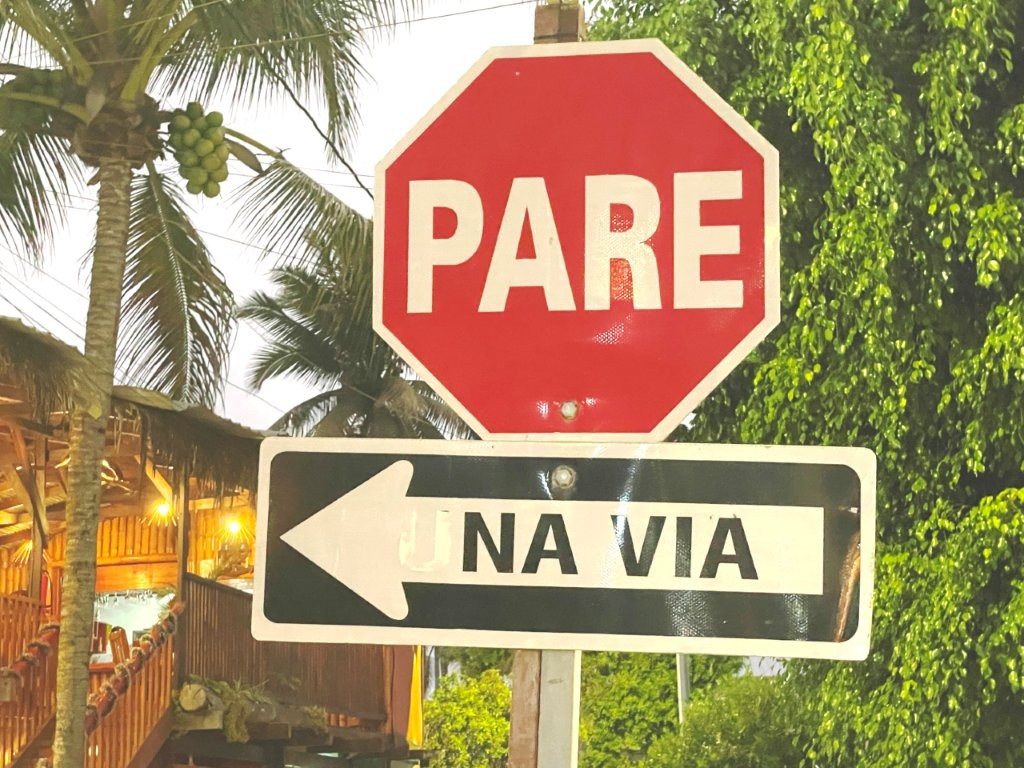
- Stop signs, yield signs, and road markings follow international standards. Most signs are in Spanish, but they use the same shapes and colors you’re used to (e.g., red octagon = stop).
- Main highways, especially those near San José, are paved and generally in decent condition.
What’s Different?
- Traffic signals are rare outside of major towns. Instead, you’ll see roundabouts, stop signs, and informal right-of-way rules that can feel a little crazy.
- Roads are often narrow, with just one lane in each direction. And no shoulder. And cars parked along the side.
- Everything is measured in the Metric system – kilometers (km) and meters (m)
- The roads curve often, meaning you can’t always see what’s around the next corner (watch the city video below)
- In towns, many streets are one-way and the gutters are deep — like 12″ deep! With practice, you’ll get good at curbside parking without dropping a tire.
- Speed bumps appear without warning, sometimes unpainted or poorly marked.
- Dogs, pigeons and chickens can randomly appear in the road without warning.

Urban vs. Rural Roads:
Once you leave the main highways, conditions can shift quickly. The roads are either well-paved and smooth (I estimate 70%). Or they are gravel or full of potholes (I estimate 30%). There doesn’t seem to be much in the middle. (See the videos below)
Bridges might be single-lane with no signage, and GPS instructions don’t always match reality.
Kari’s Travel Tip: Driving in Costa Rica always takes longer than expected. Getting stuck behind slow trucks, crawling over rough patches, and delays at popular photo stops (Hello, Crocodile Bridge), even short distances can stretch way out.
Kari’s Travel Tip: Waze is a popular navigation app in Costa Rica because it often works better when you can’t get a cell signal. But I personally find it very clunky to use. As we travel from Point A to B, it will re-route us repeatedly, often sending us in circles.
We prefer Google Maps as long as we remember to enter the destination and hit Start before we leave the Wifi of our accommodation.
Kari’s Travel Tip: With two people, it’s super helpful to have one drive while the other navigates. The roads in Costa Rica veer and swerve so often, that if you don’t stay on top of it, you’ll probably miss a turn.


How Do Addresses Work in Costa Rica? (It’s Not What You Expect)
If you’re used to typing in a house number and street name to get directions, Costa Rica’s address system will leave you scratching your head. Here, addresses are often based on local landmarks rather than actual street names.
Instead of “123 Main Street,” you’ll get an address like:
- “Two houses past Mountain Top Park, Manuel Antonio” (our first lodging)
- “From the Cerro Plano school, 150 meters east and 50 meters south” (our second lodging)
- “150 meters west of the gas station in Uvita” (Our whale watching tour meeting spot. But which gas station? There are three of them!)
This informal system works fine if you’re local and know the landmarks—but it can be a challenge for visitors relying on GPS or online booking confirmations.
Kari’s Travel Tip: Don’t count on addresses alone to get you where you’re going. Use a business name or landmark in your map app, especially for places like Airbnbs or tour departure points. When possible, confirm the exact location with your host or tour operator ahead of time.
Kari’s Travel Tip: Know which province you are in. Many towns or places in Costa Rica have the same name, but are located in different provinces (which are equivalent to our states). If you don’t double-check, your GPS might send you to the wrong one—sometimes hours away.
Try typing Playa Hermosa into your maps or weather app – 5 different options come up. Which is the one you want to go to?


Manuel Antonio / Quepos is in Puntarenas. Tamarindo is in Guanacaste. Arenal / La Fortuna is in Alajuela. Monteverde is in Puntarenas, but Guanacaste is just a few km away. San Jose is in San Jose, but our hotel by the airport was in Alajuela.
Night Driving, Gas Stations, and Other Safety Tips
Driving After Dark: Why It’s Not Recommended
Technically it’s allowed. But that doesn’t mean it’s a good idea.
Street lighting is rare once you’re outside the cities. Potholes, narrow roads, and unexpected detours are much harder to spot at night—and livestock or pedestrians can appear suddenly, especially in rural areas.
Interesting, it gets dark about 5:30 – 6:00 PM, all year long. If you land in San Jose after 2:00 pm, it would be wise to spend the night there and head out to your destination the next morning.
Crime is also more likely after dark, particularly in isolated areas or at popular tourist stops where people hop out to take a quick picture.
Kari’s Travel Tip: If you must drive at night, stick to main roads and well-known routes. Avoid remote areas and double-check your destination before setting out.
How Gas Stations Work in Costa Rica
Gas stations are full-service in Costa Rica—you won’t be pumping your own gas here.
An attendant will fill your tank, and it’s customary to stay in the car while they do. Pay in colones, and always ask for a receipt. Double-check it before driving away to make sure you were charged correctly.
Are there any toll roads in Costa Rica?
There are just a few toll roads, all near San José, including Route 27 and parts of Highways 1 and 2. Unless your rental car has a toll transponder in it, you’ll need Costa Rican colones to pay. Look for the lane marked “Manual” to pay with cash.
Driving Restrictions in San Jose
In the capitol city of San Jose, there are driving restrictions in place to reduce the amount of cars on the road. Based on the on the last digit of your car license plate, you may NOT drive within city limits between 6:00 AM and 7:00 PM on these days:
- Mondays – plates ending in 1 or 2
- Tuesdays – plates ending in 3 or 4
- Wednesdays – plates ending in 5 or 6
- Thursdays – plates ending in 7 or 8
- Fridays – plates ending in 9 or 0

Parking: What You Need to Know
You can usually park for free along the curb—as long as the curb isn’t painted yellow. But be careful: many streets have deep gutters along the edge, which can be tricky to spot. Practice pulling in close without dropping your tires into the gutter.
In towns and tourist areas, you’ll often encounter unofficial parking “attendants”—locals who offer to watch your car for a small fee. They’re not employed by any business or government, but they are a common part of the culture here.
Kari’s Travel Tip: So far, we’ve paid elderly women in lawn chairs and men in reflective vests to watch our car while we went horseback riding or explored a trail. Expect to pay ₡1,000–2,000 (about $2–4 USD) as a courtesy. It’s a small price for peace of mind.

Theft Prevention: Be Proactive
The most common crime in Costa Rica is theft—especially from parked cars. It can happen quickly and without warning, even in daylight or near busy tourist stops.
Kari’s Travel Tip: Always lock your car and take everything with you, even if you’re just running into a store or bathroom. Don’t leave valuables in the trunk, glovebox, or under a seat. If two people are traveling, take turns staying with the car when stopping at scenic viewpoints or grocery stores.
Kari’s Travel Tip: I always carry my camera, laptop, medications, and passport in my backpack—even inside a grocery store or market. That way, if something happened to the car, I still have all of my essentials.
FAQs About Driving in Costa Rica
Is it safe to drive in Costa Rica?
Yes—with a few caveats. Most travelers have no problems as long as they drive cautiously, especially in rural areas or after dark. Roads can be unpredictable, and theft from parked cars is a known issue, so it’s important to stay alert and take smart precautions.
Do I need a 4×4 vehicle to drive in Costa Rica?
Not always. Many popular destinations are accessible with a standard car, but if you’re headed to mountainous regions, unpaved roads, or more remote areas, a 4×4 can make a big difference—especially during the rainy season.
Kari’s Travel Tip – being off the ground is more important than have a 4×4 – our rental was a medium sized SUV, without 4W drive. We just crawled slowly over all the bumps and ruts and took our time.
How long does it take to drive across Costa Rica?
Costa Rica looks small on the map, but don’t let that fool you. Travel times are often much longer than GPS estimates suggest. A 100-kilometer trip could take 3–4 hours depending on road conditions, traffic, and stops.
Do I need an international driver’s license?
No. US and Canadian drivers can legally drive in Costa Rica with their regular license for up to 90 days. Just be sure to carry it with you at all times.
Conclusion: Is Driving in Costa Rica Worth It?
If you’re up for a little adventure, driving in Costa Rica is one of the best ways to see the country on your own terms. You’ll have access to hidden beaches, quiet villages, and stunning viewpoints you’d miss on a bus or shuttle.
But it’s not for everyone. The roads can be rough, directions are often vague, and driving at night adds another layer of risk. If that sounds more stressful than exciting, you might be better off with a private driver or booking guided tours.
Kari’s Travel Tip: For confident drivers with a flexible schedule and a good travel partner to navigate, renting a car and hitting the road in Costa Rica can be incredibly rewarding—just go in with eyes wide open and a full tank of gas.
More Info on Costa Rica
Here are some more posts about Costa Rica, including some that I’m still working on. If you’d like to receive emails when I’ve posted new content to the site, please complete the short form above.
- Amazing Costa Rica 7 Day Itinerary for Nature Lovers
- Ultimate 2 Week Costa Rica Travel Itinerary for Nature Lovers
- What to Pack for Costa Rica: A Nature Lover’s Packing List
- Costa Rica Facts & Travel Tips – For First Timers
- Colorful Birds of Costa Rica – A Photo Album
- Sodas in Costa Rica – An Affordable & Delicious Experience
- How to Make the Most of Your Day at La Paz Waterfall Gardens
- Buy Costa Rica National Park tickets without pulling your hair out
- Everything You Need to Know about Driving in Costa Rica
- Costa Rica on a Budget: Lodging, Food & Fun For Less
Monteverde / Santa Elena Rainforest Area
- Where to stay in Monteverde / Santa Elena – Luxury to Budget to Unique
- 20 Epic Things to do in Monteverde / Santa Elena
- Where are the Best Places to Find Birds in Monteverde?
- 14 Awesome Cheap and Free Things to Do in Monteverde
Manuel Antonio / Quepos Area
- Manuel Antonio National Park: How to Have an Amazing Day
- Beyond the Park: 25 Great Things to Do in Manuel Antonio
- The 12 Best Hotels in Manuel Antonio & Quepos for Every Budget
- Carara National Park: Macaws, Monkeys & the Crocodile Bridge
- Whale Watching in Costa Rica at Marino Ballena National Park
- 12 Best Free and Cheap Things to Do in Manuel Antonio / Quepos
La Fortuna / Arenal Volcano Area
- 10 Best Places to Stay in La Fortuna Costa Rica
- Don’t Miss These 24 Unique Things to Do in La Fortuna
- Our Costa Rica Cooking Class – Did it Live up to the Hype?
- 10 Best Free and Cheap Things to Do in La Fortuna / Arenal
