
From safety to money to driving, these are the Costa Rica travel tips I wish I had known before I went
Planning your first trip and not sure what you actually need to know before you go? This Costa Rica travel guide pulls together the practical Costa Rica travel tips that matter most for first-time visitors, from money and safety to driving, weather, language, and entry requirements.
Bill and I keep coming back to Costa Rica for a reason. It is one of those places that feels both adventurous and approachable, and after multiple visits and an extended stay, these are the things I think will make your trip planning easier and a whole lot less stressful.
Use the Table of Contents to jump to what you need, or read straight through for a simple, helpful overview packed with Costa Rica facts and first-hand travel advice.
Quick Costa Rica Travel Guide for First-time Visitors
Before we get into the details, here are a few Costa Rica facts that will help you get your bearings quickly.
- Official currency: Costa Rican colones (CRC or ₡)
- Language: Spanish
- Country phone code: +506
- Time zone: Central Time, but Costa Rica does not observe Daylight Saving Time
- Electrical outlets: Same Type A and B plugs used in the US
- Driving side: Right side of the road
- Tap Water: Usually safe in most areas, but always ask at your lodging in remote destinations
Kari’s Travel Tip: If this is one of your first international trips, Costa Rica is a very approachable place to start. It feels exciting and adventurous without being too overwhelming.
Is Costa Rica Safe to Travel? Safety Tips for First-time Visitors
If safety is one of your biggest concerns, you are not alone. It is one of the most common questions people have when planning a trip here.
In my experience, Costa Rica feels very travel-friendly, but safety in Costa Rica travel mostly comes down to theft prevention and using common sense. Theft from cars is the issue I hear about most, not violent crime directed at tourists.
Here are my biggest Costa Rica travel tips for staying safe:
- Never leave anything visible in your car
- Better yet, do not leave anything in your car at all
- Do not leave belongings unattended at the beach
- Keep your valuables on your person, even for quick stops. I always took my backpack with me when we left the car, even to go into a grocery story.
- Stay aware of your surroundings in busy tourist areas
- Lock your car every single time you get out
- Use extra caution at popular viewpoints, beach access points, and town signs where travelers often stop for photos
I carried my purse, meds, laptop, and camera in my backpack almost everywhere. Was it a little annoying? Yes. Was it worth it for peace of mind? Also yes.
Kari’s Travel Tip: If I could give only one piece of Costa Rica travel advice, it would be this: never leave your stuff in the car. Not while you run into a store. Not while you use the restroom. Not while you take a quick photo.
The State Department’s STEP program is also worth considering before any international trip. We always register our travel details so we can receive alerts about protests, strikes, emergencies or major changes that could affect our plans.


PLAN YOUR TRIP WITH OUR
FAVORITE TOOLS
– Best Lodging site: Booking.com
– Book Day Tours here: Viator.com
– Rent Cars here: RentalCars.com
Costa Rica Travel Tips for Money, Cash and Credit Cards
The official currency in Costa Rica is the colón, but US dollars are accepted in many tourist-friendly places. If you pay in dollars, your change will usually come back in colones.


Paper banknotes: ₡1,000, ₡2,000, ₡5,000, ₡10,000, ₡20,000
Coins: ₡1, ₡5, ₡10, ₡25, ₡50, ₡100, ₡500
A few money basics to know:
- Small businesses may not accept large US bills like $50s or $100s
- US cash should be clean and undamaged – they will inspect it and reject if there are tears or creases or marks
- Credit cards are widely accepted in many places
- We were able to use Apple Pay in a few places too
- Cash is still necessary in certain situations:
- Smaller shops and restaurants
- “Parking attendants” (see below)
- Independent tour guides who are not set up to take card payments
- We pay for most of our accommodations on booking platforms with a credit card. But in Costa Rica, it is far more common be asked to pay for your lodging in cash upon arrival, even when booked on Booking.com.
Kari’s Travel Tip: Ticos often say “mil” when they mean 1,000 colones. So if someone says “one or two mil”, they mean ₡1,000 or ₡2,000. Confused the heck out of me at first!
Costa Rica is not as cheap as it used to be. We stocked up on groceries at the Walmart after landing in San José, and a lot of the prices were actually higher than what we pay in the US. But we could get familiar brands that we know and trust.
Kari’s Most Important Travel Tip: If you plan to buy liquor for your trip, check the duty-free shop at the airport. We found a 1-liter bottle of rum for $10 there, then later saw the same bottle at a grocery store for $23.
Kari’s Travel Tip: In many restaurants, you go pay at the cashier instead of at the table. They often do not bring the bill to you automatically.
Currency conversion made easy
We use the Xe app to check exchange rates.
For quick mental math, I usually divide by 500:
- ₡2,500 = about $5
- ₡5,000 = about $10
- ₡10,000 = about $20

Kari’s Travel Tips:
- You do not need to get colones before arriving in Costa Rica. Withdraw a small amount of Colones from a bank ATM once you reach your first destination
- Except if you are driving out of San José, then it helps to have a few colones cash for the tolls. This is the only time I’d recommend withdrawing cash at the airport ATMs – $5-10 is enough.
- Always choose the local currency when paying by card – it prevents double conversion fees
- Call your bank and tell them your travel dates and countries before you leave. This will prevent any issues with your card being blocked while abroad.
- Use up any leftover colones on your last day. We spend ours on snacks and beverages at the airport before we head home.
Tipping in Costa Rica
Tipping in Costa Rica is appreciated, but it is not as expected as it is in the US.
One important difference is that most restaurants and cafés automatically add a 10% service charge by law. That amount is meant to be shared among employees.
Here is the simple version:
- The 10% service charge is already included at most restaurants – look at your bill carefully.
- Extra tipping is entirely optional
- You can tip in either US dollars or colones
I still like to tip when the service is especially good, but it definitely removes some of the guesswork for first-time travelers.
Costa Rica Travel Guide for Driving and Getting Around
Costa Ricans drive on the right side of the road, just like in the US, so that part feels familiar right away.
But driving in Costa Rica still comes with a learning curve. Here is what to expect:
- Main roads are usually paved
- Many roads have just one lane in each direction
- Traffic lights are surprisingly rare. Roundabouts and stop signs are common
- Road signs are in Spanish, but the shapes are familiar
Once you leave the main highways, roads often get:
- Narrow and winding
- Bumpy with lots of potholes
- Unpaved in spots
We did not rent a 4×4, so we just slowed down and took our time over the rough patches.
Important Driving Tips
- Distances take longer than they look on the map. Google Maps and Waze often underestimate the drive times
- Big trucks can cause long backups on two-lane roads
- Popular attractions can create surprise traffic jams (like at Crocodile Bridge)
- Avoid long drives after dark when possible
- In towns, streets are often one-way. Do not park at yellow curbs.
- Gas station attendants pump the gas. Check your receipt carefully.
Kari’s Travel Tip: Read my entire guide to driving in Costa Rica
There are just a few roads in Costa Rica with toll booths. They are all around the San Jose area, including Route 27, Highway 1 and Highway 2. You’ll need Costa Rican colones to pay – choose the lane that says “Manual” for payment type.
Learn the Provinces
Costa Rica is divided into 7 provinces, and it is more important than you might think to know which one you are in. Here is the basic breakdown:
- Province = similar to a US state
- Canton = similar to a county
- District = similar to a city or local area
For example, La Fortuna is in the District of La Fortuna, the Canton of San Carlos, and the Province of Alajuela.

A lot of towns and beaches share the same name. If you type a place like Playa Hermosa into your maps app or weather app, several options may come up in totally different parts of the country.
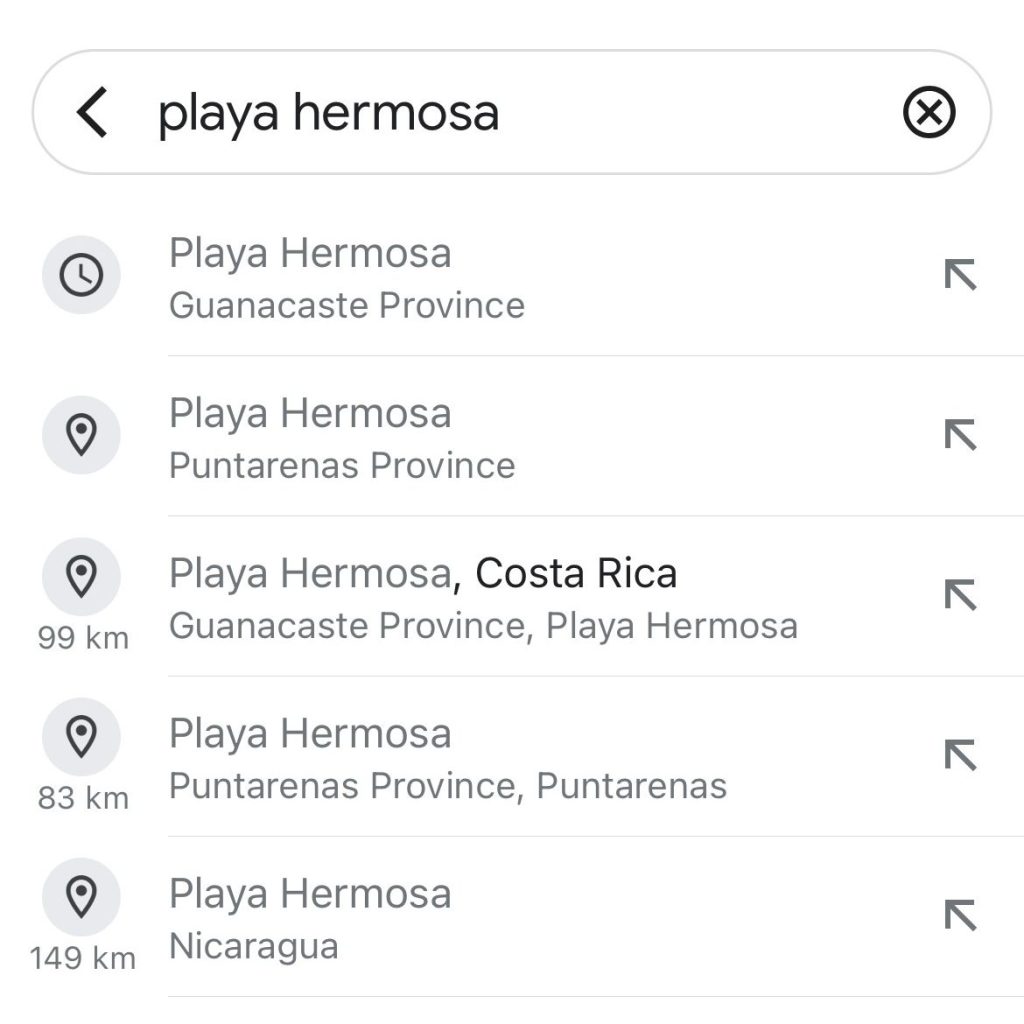
That is why I always double-check the province before going anywhere new.
Costa Rica addresses can be wildly confusing
Addresses in Costa Rica are often based on landmarks instead of street numbers.
These kinds of directions are completely normal:
- Two houses past the park
- 150 meters east of the school
- 150 meters west of the gas station
That gets confusing very quickly, especially when there is more than one gas station in town!
Kari’s Travel Tips:
- Use the business name whenever possible
- Save your hotel or activity in your maps app and hit Start before leaving Wi-Fi
- If two of you are traveling together, let one person navigate and one person drive
Waze vs. Google Maps
Waze is often recommended in Costa Rica, especially for unreliable signal areas.
I personally still prefer Google Maps because I find Waze clunky and too quick to reroute us in circles. We use Google Maps whenever we can, but I know a lot of travelers swear by Waze.
Car safety and rental costs
Never leave anything in your car. That is worth repeating.
Kari’s Travel Tips:
- Always lock the car
- Take every belonging with you
- Keep valuables on your person
- Ask for the full rental cost with insurance and fees before booking
- Do not assume the cheap quoted rate is what you will actually pay
Renting a car in Costa Rica can be expensive, so I would absolutely do your homework and ask for the total cost upfront.
Parking attendants are a real thing
One thing that surprised me in Costa Rica was paying someone to watch our car while it was parked. You may see this:
- Near beaches
- At tourist stops
- In parking areas
- Along roadsides near attractions
These are not official employees. They are usually locals trying to earn a little money. So far, we have paid: An older woman to watch our car while we went horseback riding on the beach and a man to watch our car while we went birding in the woods. In both cases, we paid about ₡1,000 to ₡2,000.
You CAN travel Costa Rica without a rental car
If you do not want to drive, you can still get around Costa Rica using buses, shared shuttles, rideshares, and private transfers. An app like Rome2Rio can help you compare:
- Route options
- Travel times
- Estimated costs

Language Tips that will make your trip easier
The official language in Costa Rica is Spanish. In tourist areas, many people working in hotels, tours, and restaurants speak at least some English, but you will absolutely run into people who do not.
That is why I think it helps to learn a few simple Spanish words phrases before your trip.
- Yes = Sí
- Please = Por favor
- Thank you = Gracias
- Hello = Hola
- Goodbye = Adiós
- Good morning = Buenos días
- Where is the bathroom? = ¿Dónde hay un baño?
- I don’t speak Spanish = No Espanol
Google Translate
For everything else, I use Google Translate. It’s my go-to app for translating both ways—whether I’m typing or speaking the words I need.
I often use it in stores to ask for things like “I’m looking for ham” or “Where are the onions?” I type or speak it, then show the employee the translation.
The camera feature is another lifesaver! I can snap a photo of a menu or food label, and Google Translate will translate it instantly.

A few other words to know as a visitor in Costa Rica:
- Tico = Costa Rican native or resident
- Playa = Beach
- Mirador = Viewpoint or overlook
- Soda = Small restaurant

Time Zone, Dates and Phone Basics
Costa Rica is in the Central Time Zone, but it does not observe Daylight Saving Time. That means:
- During US Standard time, it matches places like Chicago and Dallas
- During US Daylight Saving Time, it lines up more like Mountain Time and Denver
Sunrise and sunset stay pretty consistent year-round:
- Sunrise is usually around 6:00 AM
- Sunset is usually around 5:30 PM
- It gets dark quickly after that
We try to avoid long drives after dark because roads can be narrow, winding, and much slower than expected.
Costa Rica is great for Americans because the jet lag is minimal, if at all!
Date Format
Costa Rica formats their dates as DD-MM-YYYY, which is different from the MM-DD-YY format used in the US (where August 12, 2023 is written as 08-12-23). In Costa Rica, the date would show as 12-08-2023.
Kari’s Travel Tip: Date format is particularly important when you’re buying tickets, or when completing forms or applications. Be careful when entering your birthdate, passport issue date, and expiration date – always follow the format provided on the application!
International Phone Code
Costa Rica’s country code is +506 (followed by the 8-digit local number).
To get the + sign, press and hold the zero key for a second while in dialing mode. Then, you can add Costa Rica’s country code (506) and the local number.
WhatsApp is the primary app for calls, texts, and file sharing in Costa Rica (and many other places such as Europe and Southeast Asia).
People here don’t use traditional texting or calling services like we do in the US.

Kari’s Travel Tip: Download WhatsApp before your trip and learn how it works. It’s how you will communicate with your drivers, guides, accommodation hosts, and other travelers you meet.
We use WhatsApp to keep in touch with family while we’re abroad. As long as I’m on Wi-Fi or using my Airalo eSim for data, I avoid international roaming charges from my US carrier.
WhatsApp uses your US phone number, but it only works with others who are using the app. If you’re sharing your number, make sure to include the +1 in front of your area code. You can also create a QR code on WhatsApp for them to scan.
Airalo eSim

I use an Airalo eSim to stay connected while traveling abroad.
They offer a specific eSim for Costa Rica, or a Latin America Regional eSim that covers 17 countries across Central and South America, including Mexico.
The Regional one is a little more expensive, but useful if you will be visiting more than one country during your travels.
It’s very easy to install, activate, and use. You can select which apps use your eSim data. I usually turn off apps I don’t need while traveling, like weather apps or businesses back home.
You can always top it off with more data if needed.
Kari’s Travel Tip: Install and activate the eSim before leaving home. This way, you’ll have data ready as soon as you land and connect to the local network.
Kari’s Travel Tip: Make sure your phone is set up for international roaming and that it’s been unlocked for the eSim. If you’re not sure, call your cellular provider.
Weather in Costa Rica can Change Fast
Costa Rica’s weather varies a lot depending on where you are. In general:
- Coastal areas are often hot and humid
- Mountain areas like Monteverde can be much cooler
- Rainfall varies dramatically by region and elevation
In Monteverde, it would rain for 10 minutes, be sunny and warm for 20 minutes, then rain for an hour, then be nice for 40 minutes. It literally changed minute by minute!
And the weather apps were consistently wrong. Bill refers to AccuWeather as INACCURATEWeather in Costa Rica!
Kari’s Travel Tip: The best tip is to just plan for anything, dress in layers and ALWAYS have your rain gear with you! Whether you prefer a raincoat, an umbrella or a poncho is up to you.
Kari’s Travel Tip: If your accommodation has a tin roof, heavy rain can be incredibly loud. Light sleepers may want to avoid that when choosing accommodations.
Outlets, Water and Toilet Paper in Costa Rica
These are the little practical details first-time travelers always want to know.
Do I need a plug adapter?
If you are coming from the US, probably not. Costa Rica uses the same Type A and B outlets and the same electrical current, so most American electronics work without an adapter.


I did bring my Ceptiks Universal Travel Adapter Kit because I can plug multiple things into it at once, in case there was limited outlets available, but I never ended up using it. Still, I highly recommend – it has worked great for me, all around the world and in multiple countries.

Can I Drink the Water?
In most areas, yes. Tap water is generally safe to drink. That said:
- If you have a sensitive stomach, you may prefer filtered or bottled water.
- Some remote areas are exceptions. Your lodging will usually tell you if the water is not safe to drink.
Can I Flush the Toilet Paper?
In most places in Costa Rica, toilet paper goes in the wastebasket next to the toilet rather than being flushed. Sometimes there is a sign. Sometimes there is not. I wouldn’t flush the paper unless you know for sure that it’s safe to do so.
Costa Rica Travel Requirements for US Visitors
According to the US State Department, US citizens do not need a tourist visa to travel to Costa Rica as long as your stay is less than 180 days. You must have validity left on your US passport for your entire stay and you need at least one blank page in your passport for them to stamp.

Upon arrival at Immigration, you may be asked to show your return ticket or proof of onward travel to prove you will not stay in Costa Rica more than 180 days. So have it readily available (on your phone or on paper) to show if they ask.
Kari’s Travel Tip: Always carry your passport with you. I keep mine buried deep in an inside pocket of our backpack which I wore everywhere.
Kari’s Travel Tip: Register your travel details in the STEP (Smart Traveler Enrollment Program). We always do this before we travel internationally to get email notifications about emergencies, protests, or changes to embassy hours.
Vaccine Requirements
No vaccines are currently required for those arriving from the US. If you are coming from a country with active Yellow Fever, you may need a vaccination for that. I always recommend talking with your personal doctor before doing any international travel.
Other Helpful Things to Know for Costa Rica
These last few Costa Rica travel tips do not fit neatly anywhere else, but they are worth knowing:
- National Park tickets must be purchased online and often sell out. Set up an account before you leave for Costa Rica so you’re ready to go when you want to book.
- San Jose, Costa Rica is not the same as San Jose California or San Juan, Puerto Rico – people get them mixed up all the time, even booking flights to the wrong city! SJO is the airport you want in San Jose, Costa Rica and its official name is Juan Santamaria International Airport.
- Interested in bird-watching? Join these Facebook Groups: Costa Rica Birding or Birding Costa Rica. These groups provide info about places to find specific birds, guides to hire and popular places to go birding.
Conclusion: Costa Rica Travel Guide
I hope this Costa Rica Travel Guide has given you some valuable info to make your trip planning easier and more exciting! It’s a wonderful place to visit and I highly recommend adding it to your travel Bucket List.
If you have any other fun Costa Rica facts or tips that you think should be added, I’d love to hear your suggestions!
More Info on Costa Rica
Here are some more posts about Costa Rica, including some that I’m still working on. If you’d like to receive emails when I’ve posted new content to the site, please complete the short form above.
- Amazing Costa Rica 7 Day Itinerary for Nature Lovers
- Ultimate 2 Week Costa Rica Travel Itinerary for Nature Lovers
- What to Pack for Costa Rica: A Nature Lover’s Packing List
- Costa Rica Facts & Travel Tips – For First Timers
- Colorful Birds of Costa Rica – A Photo Album
- Sodas in Costa Rica – An Affordable & Delicious Experience
- How to Make the Most of Your Day at La Paz Waterfall Gardens
- Buy Costa Rica National Park tickets without pulling your hair out
- Everything You Need to Know about Driving in Costa Rica
- Costa Rica on a Budget: Lodging, Food & Fun For Less
Monteverde / Santa Elena Rainforest Area
- Where to stay in Monteverde / Santa Elena – Luxury to Budget to Unique
- 20 Epic Things to do in Monteverde / Santa Elena
- Where are the Best Places to Find Birds in Monteverde?
- 14 Awesome Cheap and Free Things to Do in Monteverde
Manuel Antonio / Quepos Area
- Manuel Antonio National Park: How to Have an Amazing Day
- Beyond the Park: 25 Great Things to Do in Manuel Antonio
- The 12 Best Hotels in Manuel Antonio & Quepos for Every Budget
- Carara National Park: Macaws, Monkeys & the Crocodile Bridge
- Whale Watching in Costa Rica at Marino Ballena National Park
- 12 Best Free and Cheap Things to Do in Manuel Antonio / Quepos
La Fortuna / Arenal Volcano Area
- 10 Best Places to Stay in La Fortuna Costa Rica
- Don’t Miss These 24 Unique Things to Do in La Fortuna
- Our Costa Rica Cooking Class – Did it Live up to the Hype?
- 10 Best Free and Cheap Things to Do in La Fortuna / Arenal
